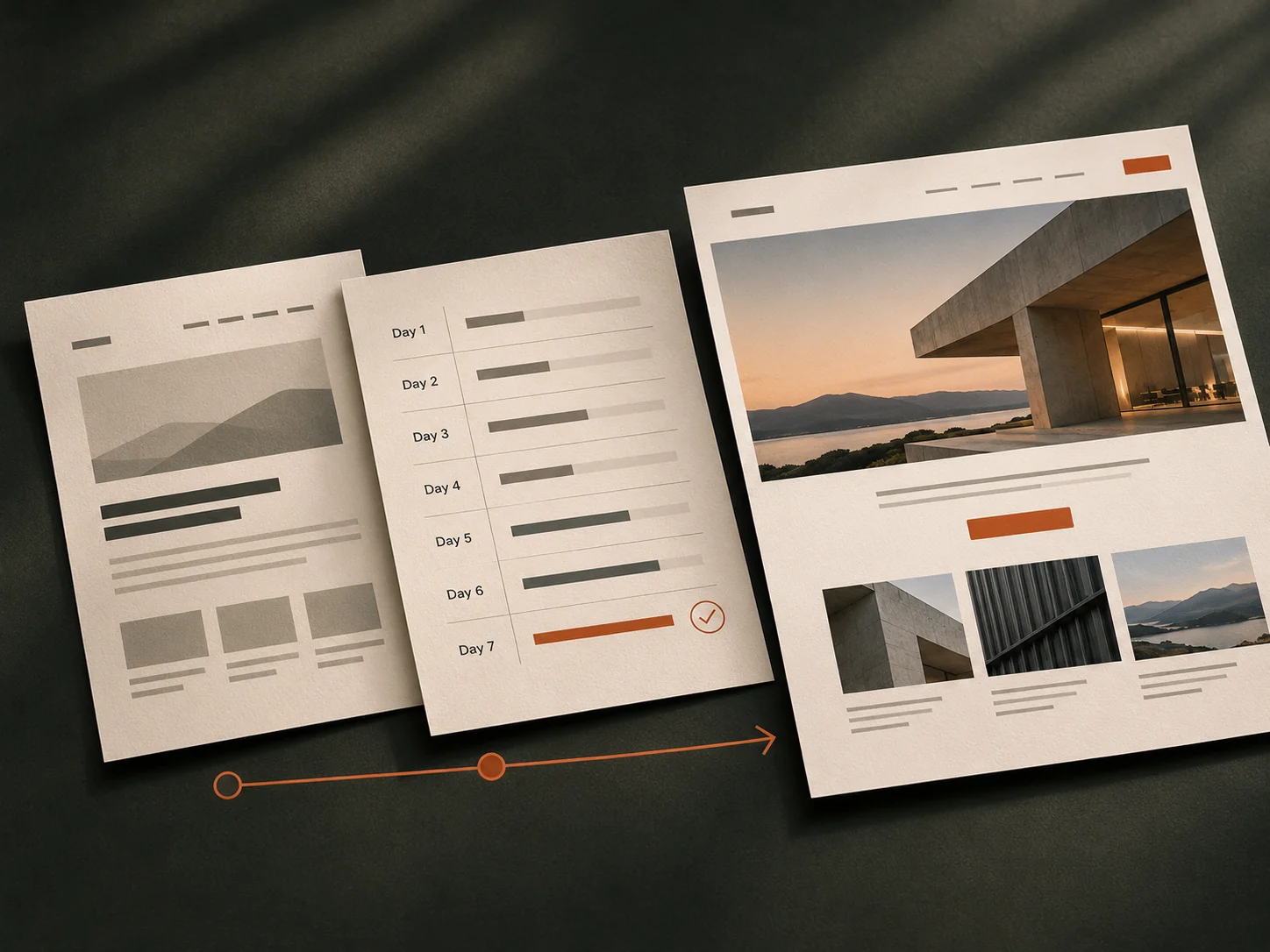
Yes, a straightforward business website can sometimes be delivered in around one week. The useful question is what must already be settled for that to happen. A short build works when the scope is contained, the necessary content is available and the people approving the site can respond during the agreed review windows.
That is a possible delivery period for a suitable project, once a start date is booked. It is not a promise that every enquiry on Monday becomes a live website by Friday.
Define when the week begins
The clock needs a clear starting point: agreed scope and price, available production time, approved material and working access to the necessary accounts. Time spent deciding the services, commissioning photographs or locating a domain login still exists, even if it happens before the build.
Confirm whether “a week” means five working days, how bank holidays affect it, and whether the proposed finish means a review-ready site or a checked, approved launch. Those distinctions matter when you are planning an event or replacing a website before a campaign.
Our general website timeline guide includes an illustrative four-week brochure-site programme, with preparation and review spread across separate stages. A concentrated build brings ready inputs and available reviewers together. It does not remove those stages or make that longer example wrong.
Look for a small, settled brief
A compact brochure website for an established professional practice may be a candidate: a homepage, services, selected work, about page and contact route, with clear information and a straightforward enquiry form. The number of pages alone does not settle the question. Five pages can contain very different amounts of work.
Consider a hypothetical surveying practice that already has approved service descriptions, staff biographies, photographs and a settled visual identity. It needs a clearer presentation of its existing offer, using its current domain. That is a different task from deciding its positioning, rewriting all the copy and connecting a new booking system.
Use our guide to what a five-page business website should include to test whether a compact structure genuinely fits your customers’ needs.
Have the inputs ready before reserving the build
A folder labelled “website bits” is a beginning. Production needs a little more certainty. Check that you can supply:
- An agreed page list, with a clear purpose for each page.
- Accurate copy, contact details and service information, with factual approval complete.
- Usable logo files and photographs you have permission to publish.
- A decision on what existing URLs, downloads and useful content must remain.
- Arranged access to the domain, hosting and enquiry destination, as required.
- A named approver with time reserved to review the working site.
If copy editing or image preparation is included in the project, agree exactly how much. Available source material may be sufficient for limited editing; it is not the same as having an unwritten technical brochure ready for publication.
Reserve review time as carefully as production time
A short programme depends on decisions arriving when needed. Ask for review slots before the week begins, and make sure the person attending can approve the work. Someone who must then wait for a board meeting cannot provide immediate sign-off.
For the surveying practice, an early review might settle the homepage and service-page direction. A later preview could cover the complete site, followed by agreed refinements and launch checks. The exact sequence belongs in the project plan; it should leave room for the corrections that review is intended to find.
Return one consolidated set of comments. If the approver becomes unavailable, adjust the date explicitly. Silence should not become permission to launch simply because the calendar is tight.
Recognise what makes a short build unsuitable
A large product catalogue, customer accounts, payments, multiple languages or connections to stock and CRM systems need additional definition and testing. Moving a substantial article archive takes care even when the new layouts are simple. A rebrand or new photography introduces separate decisions and availability.
An existing website may also contain valuable search landing pages that do not fit a hurried five-page plan. Our SEO migration guide explains why those pages and their destinations need deliberate treatment.
Optional features can sometimes follow later, provided the first release remains complete and useful. Keep necessary business information, accessibility, enquiry testing and safe launch arrangements in the initial scope. Calling something “phase two” does not make it optional.
Keep the final checks in the week
The delivery plan should include mobile review, working links, form delivery, factual checks and client approval before release. If domain settings will change, coordinate that work with whoever manages business email. Choose a launch window when the responsible people can check the live result.
Our guide to telling a finished preview from a launch-ready website helps make that final approval specific.
Share the current site, available content and target date when discussing a website rebuild. Those details make it possible to assess a short turnaround honestly. A realistic week begins with a ready project.